3/27/12

Paleo Challenge 2012: Introduction

I've done it this time. As some of you have probably heard from either me or Danielle, I will be committing to Paleo for 30 days. Thirty stupid days. In case you didn't know, the last time I tried the Paleo Challenge I lasted about 8 hours. It was a miserable 8 hours, too. Most people were amazed I lasted that long.

Truth be told, I've avoided Paleo mostly because I've been blessed with the genetics and metabolism to maintain decent body composition and strength without giving a fuck about what I eat. Perfect examples of my nonchalant eating habits can be seen here and below:


Unfortunately, as I approach age 28 (kill me now) I feel those days of shoving all manner of food into my face are eventually coming to an end. And from the perspective of a coach/trainer, it wouldn't hurt to actually practice what I preach as far as nutrition goes. Nevertheless, there are other factors at play here...

1) Health. My father has high cholesterol and he takes statins for it, which I don't agree with for many reasons. I had my cholesterol checked roughly four years ago and my results came back high -- roughly 216. I saw a nutritionist, altered my diet a bit (whole grain bread - hooray!), went back, exact same result. For the past month I've been trying to get blood work done on a variety of biomarkers of health (HDL, LDL, TAG, LDL particle size, c-reactive protein, glucose, etc), but for some reason the entire universe is conspiring to prevent that from happening. Doctors are dickheads and labs are useless. If I have insurance that will pay for the process, why can't I get blood work done whenever the fuck I want? Why does a doctor need to recommend it? Fuck a doctor. Suck my white ass, American medicine. Anwyays, this was part of the reason it's taken so long to start this stupid challenge.

2) Injury/Inflammation. As some of you may already know, I've been dealing with a knee injury for the past six months. Official diagnosis: an ossicle (bone fragment) from Osgood Schlatter's disease causing patellar tendonitis at the tibial tuberosity. Basically, there's a tiny bone embedded in my patellar tendon causing pain/discomfort during deep squatting and lunging. I've been working around it as best I can. I've seen three physical therapists, two orthopedic surgeons, and one chiropractor. I've been icing, heating, stretching, and strengthening. Not much has improved. Surgery may still be on the table, but I'd prefer to avoid it. Since tendonitis is an inflammatory response to injury, why not try an anti-inflammatory diet like Paleo? Booyah.

There's that little fucker.

3) Discipline. Lasting only 8 hours on your most recent attempt at Paleo is pretty goddamn pathetic. I consider this an exercise in self-control. I fucking love food, especially every kind that is bad for you. I'm well aware of the effectiveness of Paleo, but I've never fully committed to it. No time like the present.

So here we are. On the cusp of something annoying. No more bread, grains, shitty sugars, or dairy (except for grass-fed butter, which I'll discuss later). In the next installment, I will post some onset information i.e. body fat percentage, before pictures, and possibly cholesterol (if I ever hear from any of these ass-wipe doctors). Over the next month, I will be talking about meal plans, sleep/stress/cortisol control, energy levels, training on Paleo while injured, and so on. Stay tuned.


NOTE: I actually began one week ago, but it took me this long to write this goddamn blog post.

3/10/12

Announcement: Olympic Lifting Class

This should be a very quick post regarding my Saturday Olympic lifting class. I say should be because I have a tendency to ramble on far longer than necessary. Much like politicians, talk show hosts, and you telling me how "super wasted" you got over the weekend. Don't care.

Here's the deal: the 2012 Capital City Open is fast approaching. It will be a one-day event held on Saturday, April 21st at Balance Gym Kalorama. So far, I've convinced, persuaded, and downright coerced close to a dozen people to compete in it. Why? Because I think they have the potential to be good lifters and I think they'll have fun.

Now, with that in mind, many of these people are still relatively new to Olympic weightlifting and will likely need all the instruction they can get. So I have decided to reserve my Saturday time specifically for these individuals to prepare them for the meet. I do apologize to everyone else who simply wants to refine and improve their technique, but I have a handful of people who are committed to competing and I owe it to them to ensure that they're aptly prepared. I hope you understand.

For those competing in the Capital City Open, here are some important details:

1) This opportunity will only be available for three consecutive Saturdays i.e. 3/24/2012; 3/31/2012; 4/7/2012.

2) You must be a Balance Gym member and obviously someone I know. No stranger danger.

3) You must be registered for the Capital City Open in order to participate. No empty promises. Demonstrate commitment and you'll be rewarded.

4) Each Saturday will be considered an open session from 4:15PM until 6:15PM. What this means is that you can show up whenever during this time frame to work on your lifts. Obviously, the entire two-hour period is recommended.

5) You can work on the snatch, clean & jerk, or both. I will not be helping with kipping pull-ups, muscle-ups, high rep box jumps, or anything else that has absolutely nothing to do with an Olympic weightlifting competition.

6) It will be free of cost. I only ask that you take advantage of it, especially if this is your first meet. The only thing more important than lifting well and having fun is not embarrassing me. That's simply unacceptable.

As far as meet preparation goes, below is the best I can do for credentials...


2/29/12

Good Vertebrations At The Lumbar Yard

First off, if you caught the Seinfeld reference, well done. Anyways, a few weeks back I stumbled upon an article by renowned strength coach Mike Boyle. The premise revolved around certain warm-up routines that are aimed at improving rotation of the lumbar spine and why these kinds of exercises can actually do more harm than good. Read the article -- it's interesting and though-provoking.

One of the exercises mentioned was the scorpion. Since this is an exercise Jeff and I both use in our warm-ups for classes, I decided to forward the article along to him. Jeff's a great coach, very enthusiastic, takes dodgeball way too seriously, and used to kick people in the face. Naturally, a nice dialogue emerged. We'll start with Jeff's reply to the email...

Solid article, i think the gist of it is saying if you do not have the strength at your full capable domain in range of motion (in this case the lumbar) you will be susceptible to injuries(?)

Now, if you were to practice minor resistance training at extended(not extreme) range of motion around any joint (in this case rotational lumbar).. would this negate this theory(?)

In a sense, you must be realistic that your body may experience, through voluntary or involuntary measures, a more extreme range of motion than the 3-5 degrees prescribed. Having a trained and strong "core", that alone will not "protect" you from not experiencing the extended range of motion at all times, so wouldn't it seem logical to still practice a somewhat extended range of motion movement, but instead all some resistance, so instead of a strict mobilization exercise, it now becomes an extended ROM strengthening exercise?

Definitely not applicable for a class size of 20, but maybe as far as giving preventative strength and mobility measures to private clients... JUST my brain running loose on thought, would love feedback, i'm gonna shoot this to Issa also, i know he does many of these in his rehab PT.

- J WEEEEZY

____________________________________________

Firstly, since I found these videos, I figured I'd start with them:

Tiger Woods
Roger Federer
Albert Pujols

Three athletes, each arguably the greatest from his respective sport. Three sports that involve a lot of trunk rotation. Amazingly though, if you watch each video and simply stare at their lumbar spine, it's always in neutral. They rotate from the hips and shoulders and keep the low back stays neutral. This is the optimal way to exert force.

Now, regarding injuries, you said, "In a sense, you must be realistic that your body may experience, through voluntary or involuntary measures, a more extreme range of motion." This is true, but I think the best approach is to develop the necessary means to prevent these ranges, not to get the joint accustomed to them, even if in a passive manner.

Having a strong/stable core may not necessarily protect you from the potential occurrence of excessive rotation, but since the goal of the core is to stabilize the spine, it's likely the best preventative measure. Pushing your lumbar spine into a range-of-motion it's not designed or intended to achieve won't do you many favors. From an injury prevention standpoint, I think it'd be more beneficial to develop and improve stability in a joint's neutral position.

Look at it this way: to prevent a neck injury, you don't load up a neck harness and put your neck into an extended ROM. Instead, you strengthen the neck itself (and the traps and upper back muscles) at its appropriate range-of-motion. Same goes for any joint that requires stability. Hell, look at the knee. For instance: Willis McGahee. To prevent that injury, he wouldn't have put his knee into hyper-extension while training for the Fiesta Bowl. The best he could do would be to strengthen the muscles around the knee accordingly to ensure it was a stable joint. That's a tough example because there's really nothing that could've prevented that injury. Shit was gnarly. See what I mean, though?

If going by the joint-by-joint approach to training (which people should pay more attention to), I look at it like this:

1) Develop range of motion in the joints that require mobility, then ensure the muscles are strong at those ranges (this is why gymnasts are so goddamn awesome, they're as flexible as yogis but strong at every range).

2) Develop stability and strength at joints that require stability.

Now, don't get me wrong, some people need a LITTLE added range to stable joints i.e. if someone is missing knee extension by a few degrees, but generally speaking, this isn't the case. How often do you see a K-Starr video where he's trying to improve mobility at the elbow?

I'm liking this back and forth we're having, brother. Good speak.
____________________________________________

Beautiful email. Thank you kind educated sir ;)
____________________________________________

Thus concluded our email exchange. Good stuff. Since this electronic conversation, Jeff and I have removed scorpions from our warm-ups. This isn't to say that mobility work throughout the body is awful. To quote brilliant physical therapist Charlie Weingroff: "Every joints needs mobility AND stability. Some need more mobility, while some need more stability."

This is even further exhibited/explained by Ido Portal, a master of human movement, below:


Obviously, what Charlie and Ido are saying makes a lot of sense and I think this is what Jeff had in mind. I certainly see the benefit of this concept, but in the population I see in typical CrossFit gyms most clientele exhibit classic movement dysfunction. This includes things like poor posture, tight hamstrings, short hip flexors, gross extension at the lumbar spine, and so on. I think for the general fitness enthusiast (CrossFit, especially) it's more important to fix these problems and strengthen the individual accordingly before worrying about things like improper alignment training. Ido commented on his philosphy expressed in that video and I will post that below.

Before this devolves into even more rambling, I will cut myself off. The purpose of this post was to give you some insight into the balance between mobility/stability and to let you know that your coaches are always focused on learning, adapting, researching, and adjusting to ensure your performance improves.

2/25/12

Control, Pt. 2

I briefly touched on the topic of control back in December. Despite my efforts, some of you still insist on working out like the goddamn Techno Viking. Note: That's not a good thing.

Some CrossFit trainers will argue the "20% slop rule" i.e. technique can break down about 20% so long as the intensity of the movement stays high. A direct quote from famed CF instructor, Pat Sherwood: "Technique only has to be good enough to increase the intensity. The goal is never perfect form. Remember, it's the speed of the set that is the goal." Now, Pat was the head coach at my Level 1 certification back in 2008 and he's a really nice and funny-ass dude, but I whole-heartedly disagree with this concept. Bryan Krahn from T-Nation offered this counter-point:

"To my mind, lifting is a learned endeavor. You practice perfect form over and over until it becomes second nature. That's especially true for Olympic lifting. How can you get good at an exercise if you force yourself to keep a set going past the point of technical breakdown? Aren't you just creating poor muscle-recruitment patterns that compete with the correct patterns?"

Speed is important; safety is more important. Intensity enhances progress, but without control, intensity is useless. The bottom line: 20% slop is a bullshit excuse to convince one's self that it's okay to move around like an idiot.

If you watch anyone who is truly elite in his or her chosen endeavor, there is one thing you will always notice: their movement is flawless.


Are you seeing a pattern here? It's called perfection. There is no wasted effort in any of their movements. Everything is fluid and smooth and relaxed and perfect. Very few people ever get to that level, but we should all always be striving for it. Everyday.

2/22/12

Get Some Fucking Perspective

Annoyed. And it starts here...


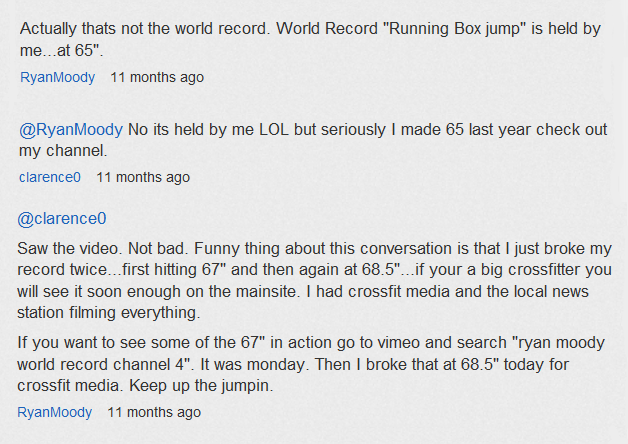
That's Noah. He's one of the coaches from District CrossFit, formerly of Potomac CrossFit. I've met Noah, he's a nice guy and a legit athlete/CrossFitter. He did a workout, jumped really high, and then whoever recorded it, uploaded it to youtube and labeled it a "world record." No big deal. So it goes. Normally, I avoid youtube comments like I avoid donating to charity, but I couldn't avoid this:


Those comments are courtesy of Ryan Moody, the self-proclaimed World Record holder for jumping on top of boxes. Or something. Basically, Ryan contacted Guiness, sent them video of his jumps, they looked into it, and he got a new world record. It was new because... ya know, no one had ever tried it before.

Look, if this guy wants to achieve a world record and go through the process of training, filming, contacting the Guiness Book of World Records, etc, then fine. That's his right. More power to him, since that all seems like a real pain in the ass. My problem with the entire endeavor is taking to youtube like an 8-year-old with a skinned knee.

"NO! That's not the world record. I have the world record!!" Dude, you're arguing over a record that NO ONE BUT YOU is trying to obtain. This isn't like the 100m dash or the fastest marathon or the long jump or whatever. This kid went to Guiness himself to be put into the record books. Meanwhile, you have this:

Steve Langton, USA bobsledder

An Olympic bobsledder hit a 62" box jump with no running start, no fan fare, no comments about him being the best box jumper, no stupid fucking celebration afterwards, and he wore a shirt the whole time. You know why? Because a max effort box jump like this is a parlor trick for him. You do it for fun just to see what you can do. You know what Langton does with the rest of his time? He devotes his life to an actual sport with real accomplishments!

This is classic CrossFit-moving-the-goalposts shit. This kid will never be an Olympian, realized he'll never win the CrossFit Games, so instead of just accepting that he'll never achieve true greatness, he decides to pursue a new world record... of jumping on stuff. Should he be proud of his jumping ability? Absolutely -- I'm assuming he's worked real hard to achieve it and that's commendable. But should he be scouring youtube trying to refute all claims of "world record" box jumps? I mean, yeah, he can, I guess... if he's a fucking loser.

1/5/12

I Guess I Have To...

When I first saw the following video, I wrote a series of rants and diatribes and saved them in my drafts. Some days passed, my anger subsided, followed by apathy and acceptance. But I figured, fuck it, hate's no fun if you keep it to yourself.

If you haven't seen it yet, watch here. It's Bob Harper's CrossFit Challenge on some asinine doctor show. In it, Bob puts Jillian Michaels and Dr. Handsome through a brief CrossFit-style workout. Bob and Jillian are both famous for yelling at fat people on The Biggest Loser. I yell at fat people on the streets of DC and I'm still waiting for Hollywood to call. But let's focus on this video.

First off, I would like to take some time to dissect Jillian Michael's performance in the workout. Considering she's lauded as one of the best trainers in the country, I expected her to man-handle Dr. High-Cheekbones. Instead, I saw the following:

1) Box jumps. Look at how caved in her knees are on her landings. This isn't good, especially considering women are highly prone to ACL injuries (JAHSP).

2) Sumo deadlift high pull. Where do I begin? This movement is dumb enough already as I discussed here, but Jillian manages to make it worse. She has no hip extension and is primarily letting her back and arms do the work. Also, a very slow eccentric portion. Basically, if you're gonna do something stupid, at least do it right.

3) Push press. She makes no use of the shelf, which limits efficiency of the movement and will further fatigue her shoulders. She's pretty much just holding the bar in her goddamn hands which is a perfect way to do it completely wrong. If you watch her last rep, check out those knees again. Bad news bears. They should be pushed out over the toes. Hard to say if she was driving through her heels as I only saw her legs during one rep, but I imagine she was creeping onto her fore-foot during the dip and drive.

4) Ball slams. These should be a powerful, hip/abdominal driven movement. Again, she seems to mainly be using her arms. The real issue here is how absurdly winded she appears to be by the conclusion of this two-minute workout.

Perhaps this isn't how Jillian typically trains. Maybe she goes running, does some light weight training, follows an absurdly caloric restrictive diet, and takes supplements. Maybe CrossFit is not her preferred method of training. But when I see how she performs during this workout, it's kinda... pathetic? To her credit, it appears that bar was loaded with 65lbs, so I can forgive that. Nevertheless, I could name roughly 10 women just from CrossFit Balance that would annihilate her in that workout. The workout lasted two minutes and she looked visibly destroyed. I just expected a little more.

A little more rabid wildebeest, for instance.

Two different, but viable claims can be made here: 1) A trainer doesn't necessarily have to be in great shape to get his or her clients great results, or 2) Jillian Michaels fucking sucks. Either one is applicable, both are obviously true. The bottom line is this: the general public thinks Jillian Michaels is an awesome trainer, while the knowledgeable people in the strength and conditioning community know she's a fraud. But really, enough about this disaster. Let's move onto Bob Harper's CrossFit Challenge...


Epic grunt 10 seconds in.

The problem with this whole stupid segment is that it highlights almost every bad aspect of CrossFit. You'd have figured CFHQ had done enough of this already. Exhibit A. Instead, this mincing vegan pussy gets on national television and shows the fat daytime viewers of America everything that's wrong about CrossFit.

1) No Instruction. Bob spends about 0.003 nanoseconds explaining to Jillian and Dr. Hairgel each movement. One could assume this wouldn't be a big deal since it's Jillian Michaels who is, presumably, competent at simple exercises she makes her clients do on a daily basis. Unfortunately, this isn't the case and we're left seeing some pretty poorly executed everything.

2) No Correction. Going hand in hand with the above, Bob offers no further instruction or correction to either subject. Instead, he yells about going faster and harder. When he does correct something, it's a cue that's relatively worthless i.e. "make sure that weight touches the ground every time." Yeah, that'll help them do it better.

3) Poor movement selection. Look at that... sumo deadlift high pulls and box jumps. Two exercises I've already criticized. Aces, Bob! Top fucking notch. High rep box jumps and a movement essentially designed to fuck up your shoulders. Bully!

Dude, you're a personal trainer; not David fucking Beckham.

Now, for the most part, this whole thing isn't a big deal. But to trainers like myself that actually want to make you stronger, fitter, hotter, awesomer, it is kind of a big deal. For the worst reasons.

While the general public may not be aware enough to see the flaws I've outlined, it lets Jillian and Bob off the hook. Meanwhile, any real athlete who has heard of CrossFit will continue to laugh at it. But the average person sees this and they see a workout that crushed Jillian Michaels (because she sucks) and they think it will make them look just like her.

So, this kind of exposure will bring clients into the door, but when their form is taught, corrected, and reinforced with light weights, people may not think they're getting what they came for. "But Jillian and Dr. Jawline just jumped right into their workout!" Well, that's not how it works. Plus that workout was stupid. So these ass clowns from The Biggest Loser, who've proven to be more cheerleader than trainer, have given some exposure to CrossFit, but in doing so, they've unknowingly emphasized many of its faults. This, in turn, makes the job of actually decent trainers more difficult.

Essentially, getting people in shape shouldn't be approached in such a willy-nilly* fashion. Therefore, the responsibility lies on us, the trainers, to let you know that safety and movement quality are far more important than intensity, speed, and acting like a bitch.


*I'm so mad that I used the phrase "willy-nilly." Surprised I haven't been censored yet.

12/2/11

SDHP: Stupid, Dangerous, Hazardous to Performance

As some of you may have noticed, there is one movement we do not teach or perform at CrossFit Balance: the sumo deadlift high pull. There is a very simple reason for this: it's dumb.

The first and most important priority of any coach is the safety of his or her clients -- at least it should be. Through firsthand experience, knowledge of basic anatomy, and seeing the movement in action, we believe the SDHP is not safe and therefore not worth doing. Instead, we'll resort to more useful exercises such as kettlebell swings and cleans.

But wait, everything is in black & white, except for his shirt.
So SDHP's have to be cool, right?

Now, rather than have you listen to me rant on about this subject, some experts far more intelligent than myself have weighed in already. We'll start with the following quote from Eric Cressey regarding the upright row, a movement nearly identical in its finishing position to the SDHP:

"I don't believe in contraindicated exercises, only contraindicated individuals. But if there's one exercise that'll ever push me over the line, it's going to be the upright row. This is as internally rotated as the humerus will get, and you're elevating the humerus right into the impingement zone on every rep. For that reason, I'll never write upright rows into a program. The dumbbell version is a slightly safer alternative, although I feel that there are still much safer ways to challenge the upper traps and deltoids. To summarize, if you've ever had a shoulder problem or are at risk, you'd be wise to omit upright rows altogether." -Eric Cressey, on T-Nation

Cressey is known in the strength & conditioning world as "the shoulder guy" and rightfully so. He, along with associate physical therapist Mike Reinold, have managed over $1 billion in shoulders. How is that possible? They've worked with countless professional baseball players, particularly pitchers.

Next is this excerpt from a Performance Menu Journal article written by renowned weightlifting coach, Greg Everett:

"I lumped this exercise in with medicine ball cleans as 'silliness' I ostensibly wouldn't allow with my own clients. This is a minor objection, but my view is simply this: Why not just perform a deadlift high-pull? What advantage does a sumo stance provide for this exercise other than making it easier, and why would we want to make it easier? If, for conditioning, we're interested in moving large loads long distances quickly, why would we shorten the distance we can possibly move the weight, and particularly in a manner that reduces the work of the legs and hips but maintains the work of the shoulders and arms?

I actually use kettlebell deadlift high-pulls in our On-Ramp program, but following those few exposures, it never comes up again. Once out of the beginning stages of learning, our clients no longer need such an exercise - they can deadlift, clean, snatch and the like with various implements. I'm not completely averse to ever doing high-pulls, as I do feel they have their place in certain situations, but the reality is that in large and frequent doses, they encourage habits that interfere with clean and snatch technique, which is already difficult enough to teach to generalists. The SDHP is absolutely not an acceptable substitute for the clean, and it should not be considered a part of a teaching progression for the clean. It is strictly a metabolic workout exercise, and, in my opinion, is not one of the better options available."
-Greg Everett, PM Journal Issue 75


This = more powerful than a SDHP.

And lastly, we have this awesome post from Dallas Hartwig, physical therapist and co-owner/operator of Whole9 - check it out, it's a great resource. I don't want to repost his entire article, so instead, it can be read here. Give it a read. It's short, informative, and has pictures!

So, mostly for the reasons mentioned above, you will not see sumo deadlift high pulls in our programming. And also, because it's dumb. Whatever this movement is trying to accomplish, can be done much safer and more effectively through other means. It's not worth the risk.

In any event, in your travels to another CrossFit gym, you may encounter a workout that employs the SDHP. Luckily, Kelly Starrett offered this mobility prescription to make it - at least - mildly safer. Regardless, you should try to avoid this movement and, by default, avoid gyms that program it for high-reps. It's dumb and you're not (I hope).